Returning to the Terrain and Reclaiming Health
Erin Holston Singh, N.D.
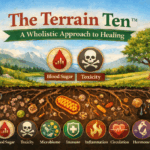
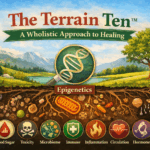
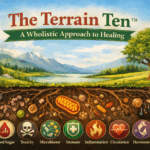
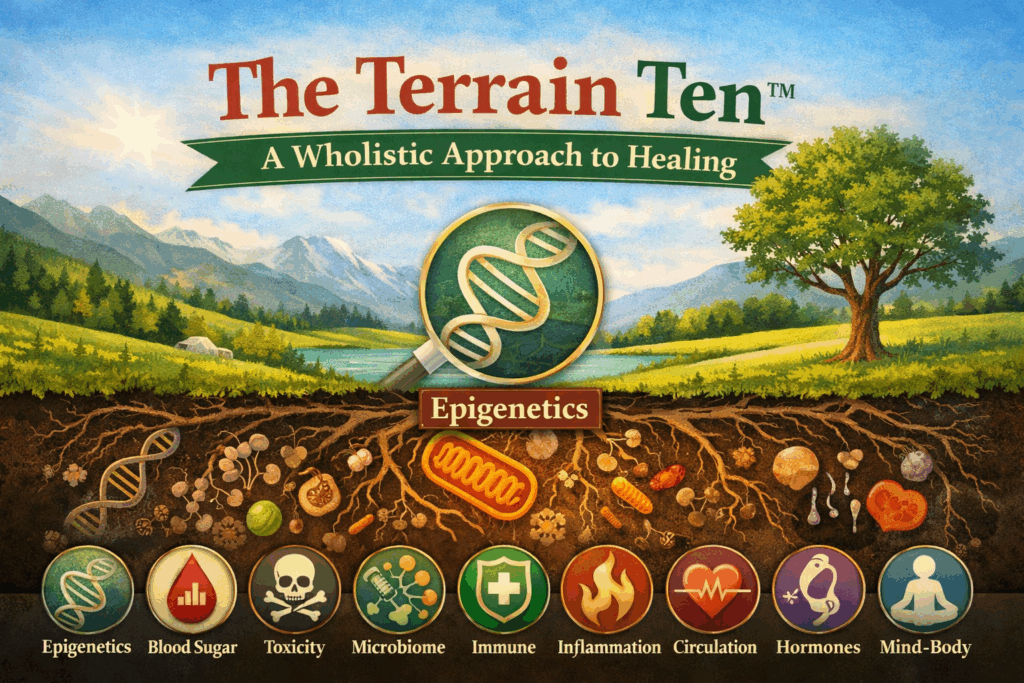
Welcome back to The Terrain Ten™ – The Key Interlinking Areas of Wellness. A terrain model that is developed by Dr. Nasha Winters. In our previous article, we introduced the concept of the terrain, the living landscape of the body that influences and reflects our state of health. Rather than reducing disease to a single cause or organ, this view invites us to consider the whole person —mind, body, and spirit —each intertwined and continually influencing one another. Now, we begin the journey of exploring the components of this terrain, one by one. We begin with epigenetics: the science of how our experiences, thoughts, and even spiritual wounds are stored in form, shaping not just our health in the moment, but also what is passed on through generations.
The Terrain Ten™ – Key Interlinking Areas of Wellness,
and the areas we will be expounding on in future
installments of this series…
1. Epigenetics
2. Blood Sugar Balance
3. Toxic Burden
4. Microbiome & Digestive Function
5. Immune Function
6. Inflammation and Oxidative Stress
7. Blood Circulation & Angiogenesis
8. Hormone Balance
9. Stress & Biorhythms
10. Mental & Emotional Health
What Is Epigenetics?
In simple terms, epigenetics refers to the way our genes are expressed—not whether we have “good” or “bad” genes, but whether those genes are turned on or off. Genes are like musical instruments in an orchestra. Epigenetics is the conductor, determining which ones play and when. And that conductor is deeply influenced not only by food and environment, but also by our thoughts, emotions, beliefs, and even ancestral memories.
This is not science fiction—it is the unfolding truth that researchers across the world are now confirming: our biology is not fixed. It responds to the inner landscape of our lives—how we feel, how we think, how we love, or hold back from loving.
Iniquity, Inheritance & Healing
In the Book of Exodus, we read that the iniquities of the fathers are visited upon the children to the third and fourth generation. Many interpret this as punishment. But in the light of epigenetics, we might instead understand it as a sacred echo—a passing forward of unhealed wounds, patterns of fear, or unresolved trauma that become encoded in the way genes are expressed in the body.
When a child grows up in an atmosphere of worry, harshness, or emotional repression—even if well-intentioned—it creates a biochemical imprint. Likewise, a parent who carries grief or guilt but never speaks of it may unknowingly pass down that heaviness in the form of recurring illness, depression, or even physical conditions.
These aren’t moral failings. They are calls for healing. Epigenetics confirms what scripture and the spirit have long taught: that healing is possible and that it begins in the heart.
The Emotional Roots of Illness
In my years of naturopathic practice, I have seen time and again that the body speaks the truths the heart cannot say. When someone is silenced—whether by fear, culture, shame, or duty—those unspoken emotions often find another path. They may experience tension in the back, tightness in the chest, or even a diagnosis later in life.
Illness is not punishment. It is a sacred signal—a whisper from the soul asking to be heard. Through the lens of epigenetics, we now know these signals are not only spiritual—they are biochemical. Hormones, neurotransmitters, and inflammatory messengers all respond to our inner world. This is where science meets the soul.
Faith as Medicine
In the Plain communities, your lives are filled with faith, service, and humility. These are not just spiritual virtues—they are epigenetic influences. Studies now show that prayer, stillness, gratitude, and loving community all change the expression of genes. They quiet the stress response, improve immune function, and enhance healing.
When we forgive, we shift chemistry. When we grieve fully, we cleanse our cellular memory. When we love freely, our bodies respond by releasing molecules of repair and regeneration.
In short, Faith, when embodied, becomes biology.
A New Covenant of Consciousness
We are living in times where inherited burdens—both personal and collective—are surfacing for healing. Whether it is chronic illness, mental unrest, or unexplained fatigue, the question is not “What is wrong with me?” but rather:
“What has not yet been felt, forgiven, or freed within me?”
The answer may lie not only in diet, detox, or supplements (though those help), but in the stillness of your heart, the honesty of your tears, and the courage to face what you have long avoided.
Epigenetics invites us into a new covenant—one where we walk in awareness of how our thoughts, choices, and feelings ripple through our bodies, and through the generations to come. Just as we honor the fields we plant and the homes we build, so too must we honor the inner terrain, where spirit and cell meet.
The Invitation
You are not broken. You are not bound by your genes. And you are not alone.
The body is designed to heal. But sometimes, it needs us to listen before it can. Whether you find that listening in prayer, journaling, circle sharing, or time in nature, trust that every step you take toward truth is a step toward healing—not only for yourself, but for your children and grandchildren.
As it is written: “He will restore the years the locusts have eaten.”
Let us walk together toward restoration—one cell, one feeling, one faithful breath at a time.
What’s Next…
In future installments, we will explore each of The Terrain Ten in detail, offering simple insights and guidance on how to restore each area—step by step.
This is not a quick fix, but a deeply respectful approach that works with the body, not against it. It is a return to natural law and to a way of seeing the body as part of the larger creation. If you or a loved one is facing illness—or simply wants to stay well—know this: the path to healing is not hidden. It begins with tending the terrain.